How a German Sausage Became the Most American Thing at the Ballpark
How a German Sausage Became the Most American Thing at the Ballpark
If you were designing a food to represent American culture, you probably wouldn't start with a German immigrant sausage stuffed into a soft roll and dressed with condiments that trace their own roots to China, England, and the American Midwest. And yet here we are. The hot dog is arguably the most American food there is — and it got that way through a combination of immigrant hustle, accidental branding, and the transformative power of the right setting at the right moment.
The story of how a frankfurter became a cultural touchstone is, at its core, a story about how context shapes identity.
It Started in Frankfurt — Or Maybe Vienna
The sausage at the center of this story has a disputed birthplace, which feels appropriate given how much of its later history involves competing claims.
Frankfurt, Germany argues the frankfurter was developed there in the late 1400s. Vienna — Wien in German, which is where "wiener" comes from — makes a rival claim, pointing to a butcher named Johann Georg Lahner who allegedly brought a variation of the sausage from Frankfurt to Vienna in the early 19th century and refined it. Both cities have celebrated anniversaries. Neither has definitively won the argument.
What's not disputed is that the thin, smoked, pork-and-beef sausage that would become the hot dog was a Central European product, refined over centuries by German-speaking butchers, and brought to the United States by German immigrants in the mid-to-late 1800s.
The Immigrant Neighborhoods That Built the Market
By the second half of the 19th century, German immigration to the United States was enormous. Cities like Cincinnati, Milwaukee, Chicago, and New York developed dense German-speaking neighborhoods with butcher shops, beer halls, and delicatessens that served the foods immigrants had grown up with. Frankfurters — cheap, filling, easy to make in quantity — were a staple.
Street vendors began selling them from carts, particularly in New York. They were affordable, portable, and required no utensils. For working-class urban populations who didn't have time for sit-down meals, a sausage in a roll was ideal. The food was already spreading before anyone thought to give it a properly American identity.
The Name Nobody Can Fully Agree On
The term "hot dog" is almost as contested as the sausage's European origins. The leading theory is that it emerged as slang sometime in the 1890s, possibly referencing persistent (and largely unfounded) rumors about the contents of cheap sausages — specifically, that they might contain dog meat. Whether the name was meant as a joke, a warning, or just a vivid piece of street slang, it caught on.
The earliest known printed use of "hot dog" in reference to the sausage appears in an 1892 New Jersey newspaper. By the late 1890s, the term was showing up in college publications and city papers. It was informal, slightly irreverent, and perfectly suited to the food's scrappy street-food image.
Some vendors reportedly hated the name and refused to use it. It spread anyway.
The Ballpark Changed Everything
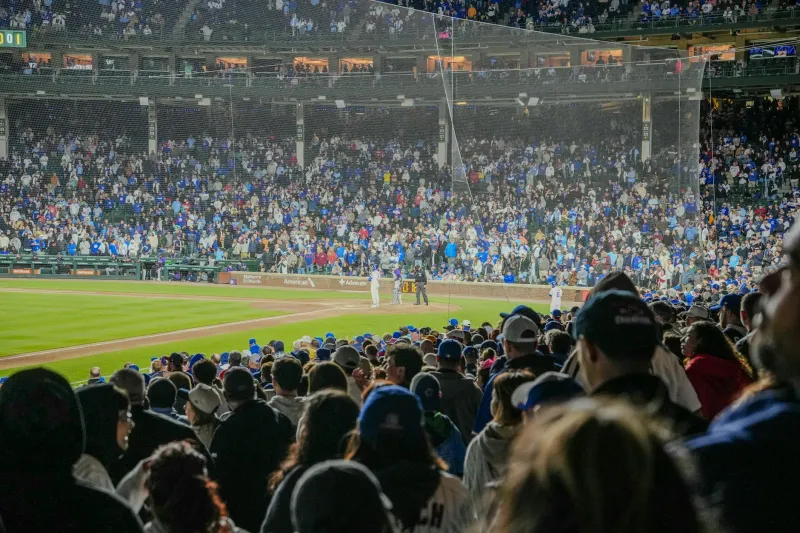
Street carts made the hot dog popular. Baseball made it American.
The connection between hot dogs and baseball is usually traced to the 1890s and early 1900s, when vendors began selling sausages in the stands at ballparks across the country. The precise moment of origin is debated — various parks and vendors claim the distinction — but the dynamic is clear: baseball games drew enormous, mixed crowds, and those crowds needed fast, cheap food they could eat while watching.
The hot dog fit perfectly. It was one-handed, relatively tidy, and inexpensive enough that almost anyone in the stands could afford one. It required no plate, no fork, no table. You could eat it while cheering, arguing with the guy next to you, or standing up for a seventh-inning stretch.
Chris Von der Ahe, a German immigrant who owned the St. Louis Browns in the 1880s, is among the early figures credited with aggressively promoting food and drink sales at games. Harry Stevens, a concessions entrepreneur who worked stadiums in New York and elsewhere around the turn of the century, is often cited as a key figure in popularizing the hot dog as a ballpark staple — reportedly selling them with the cry "Get your red hots" on cold days when ice cream wasn't moving.
The details are fuzzy, as origin stories often are. What's clear is that by the early 20th century, the association between hot dogs and baseball was already being treated as obvious and natural — which meant it had already completed its transformation from fact to mythology.
A 1939 White House Party Sealed the Deal
If one moment crystallized the hot dog's American identity for the rest of the world, it might be the 1939 picnic at Hyde Park, New York, where President Franklin D. Roosevelt served hot dogs to King George VI and Queen Elizabeth of Britain. Eleanor Roosevelt reportedly suggested the menu. The international press covered it with a mixture of amusement and bafflement.
Roosevelt's choice was deliberate — hot dogs as a statement of democratic, unpretentious American culture served to the British monarchy. The food's immigrant origins were nowhere in the story. By 1939, the hot dog was simply American.
What Place Does to Food
The hot dog's journey from German butcher shops to presidential picnics is a lesson in how thoroughly a food can be remade by its context. The sausage didn't change much. The bun was a practical addition. The condiments shifted over time. But what really transformed the frankfurter into an American icon was where it was eaten — in ballpark stands, at street corners during the industrial boom, at a White House lawn party — and the stories that accumulated around those places.
Food doesn't exist in a vacuum. It carries the rooms and the crowds and the occasions where it was served. The hot dog carries a century of American summers, of baseball afternoons, of immigrant neighborhoods and national mythology.
That's not a recipe. That's a story. And stories, it turns out, are what make a food last.