The Pickle Empire Built on a Burger Accident
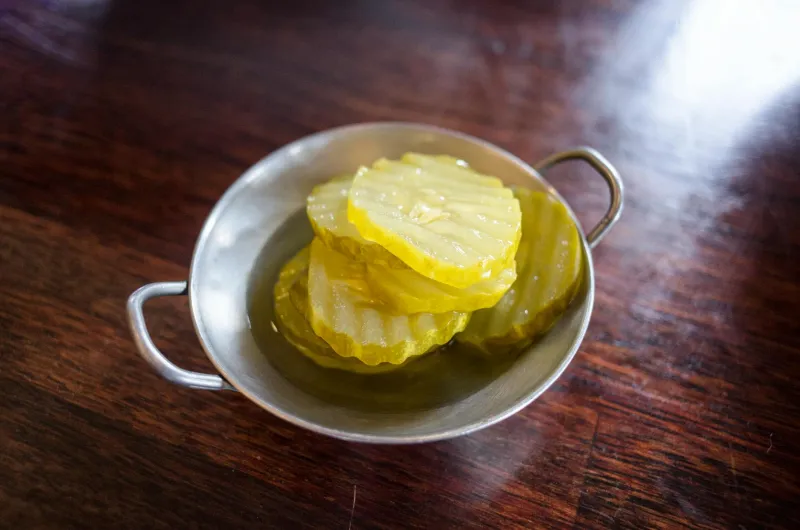
The Condiment Nobody Ordered
Here's a question that should keep you up at night: when did Americans collectively decide that hamburgers needed pickles? The answer is we didn't. The pickle infiltrated America's most iconic food through a combination of food science, economic necessity, and what can only be described as the most successful stealth marketing campaign in culinary history.
Today, the pickle industry generates over $2 billion annually in the United States, with roughly 70% of that revenue tied directly to fast food hamburger sales. That's an empire built almost entirely on a condiment that most people either love passionately or remove immediately.
Ancient Mesopotamian Food Hacking
The pickle's origin story begins 4,000 years ago in ancient Mesopotamia, where people discovered that cucumbers preserved in salt water could survive months without refrigeration. This wasn't gourmet cooking — it was survival technology. Fermented vegetables provided essential nutrients during winter months when fresh produce was unavailable.
The technique spread across trade routes, with each civilization adding its own twist. Romans carried pickled vegetables on military campaigns. Medieval Europeans used them to prevent scurvy on sea voyages. By the time European immigrants arrived in America, pickle-making was standard household knowledge.
The Great American Pickle Boom
America's pickle obsession began in the 1850s when German and Eastern European immigrants brought their fermentation recipes to cities like New York and Chicago. Jewish delis popularized the "pickle barrel," where customers could select their preferred level of sourness.
 Photo: New York, via cdn.pixabay.com
But the real breakthrough came during World War II, when the U.S. military discovered that pickles provided essential vitamins and minerals to soldiers while lasting indefinitely in field conditions. The government purchased 40% of America's pickle production for military rations, creating massive industrial capacity that needed new markets after the war ended.
The Fast Food Chemistry Experiment
In the 1950s, as hamburger chains began standardizing their recipes, they faced a significant problem: beef quality was inconsistent, and refrigeration was unreliable. Ground meat could taste bland, greasy, or sometimes slightly "off" depending on storage conditions and supplier quality.
Food scientists discovered that acidic condiments could mask these flavor inconsistencies while adding what they called "palate cleansing" properties. Pickles provided the perfect solution — their acetic acid cut through fat, their salt enhanced other flavors, and their crunch added textural contrast to soft buns and meat.
This wasn't a culinary decision made by chefs; it was a quality control measure implemented by food engineers.
McDonald's Makes It Official
The pickle's permanent place on the American hamburger was essentially decided by McDonald's in the 1960s. As the chain expanded nationally, they needed condiments that would taste identical in Miami and Minneapolis, regardless of local supplier variations.
Pickles solved multiple problems simultaneously: they were shelf-stable, provided consistent flavor, and were cheap to source in massive quantities. The decision to include them as a standard topping rather than an optional add-on was purely economic — it was easier to train employees to assemble identical burgers than to customize each order.
McDonald's pickle specifications became industry standard: thin slices, specific brine concentration, and uniform size. Other chains followed suit, not because they loved pickles, but because consumers began expecting them.
The Accidental Taste Profile
What's remarkable is how perfectly the pickle complements the standard American hamburger, despite being added for entirely practical reasons. The acidity balances fat, the salt enhances umami flavors, and the crunch provides textural contrast that makes the entire sandwich more satisfying.
Food scientists now recognize this as an example of "accidental optimization" — when practical decisions create unexpectedly successful flavor combinations. The hamburger-pickle pairing works so well that it's been reverse-engineered into other foods, from pickle-flavored chips to pickle juice cocktails.
The Pickle Industrial Complex
By the 1980s, fast food chains were purchasing pickles by the millions of pounds, creating a specialized industry focused entirely on hamburger-specific products. Companies like Vlasic developed proprietary hamburger pickle slices that were thinner, crunchier, and more uniform than traditional deli pickles.
This industrial focus led to innovation in pickle technology (yes, that's a real field). Modern hamburger pickles are engineered for optimal "mouth feel," specific acidity levels, and visual appeal. The pickle on your Big Mac has been scientifically optimized in ways that would baffle ancient Mesopotamian fermenters.
The Great Pickle Divide
Despite their ubiquity, pickles remain America's most polarizing condiment. Roughly 40% of Americans regularly remove pickles from their burgers, creating a massive waste stream that restaurants have learned to factor into their costs.
This has led to the strange phenomenon of "pickle culture" — online communities dedicated to pickle appreciation, restaurants that specialize in pickle-forward dishes, and a thriving secondary market for pickle-flavored everything. The condiment that snuck onto hamburgers through economic necessity has spawned an entire subculture.
Digital Pickle Phenomena
Social media has amplified pickle culture in unexpected ways. TikTok pickle challenges, Instagram-worthy pickle boards, and YouTube pickle taste tests have turned a utilitarian condiment into content gold. The hashtag #pickletok has generated millions of views, proving that even accidental food trends can develop passionate online followings.
This digital enthusiasm has driven innovation in the pickle industry, with craft producers creating artisanal varieties specifically for social media appeal. The humble hamburger pickle has evolved into a gourmet category that would be unrecognizable to the food engineers who first added them to burgers for purely practical reasons.
The Unintentional Empire
The pickle industry's success story is essentially an accident that became institutionalized. What started as a solution to inconsistent beef quality became a defining characteristic of American fast food, which spawned an entire industry, which created a cultural phenomenon.
Nobody set out to build a billion-dollar pickle empire on hamburger sales. It happened because practical decisions made by food engineers in the 1950s created consumer expectations that became cultural norms that drove industrial innovation.
The next time you bite into a hamburger, remember: you're participating in a 4,000-year-old food preservation tradition that accidentally became America's most successful condiment story. The pickle didn't conquer the hamburger through superior flavor — it won through superior chemistry, economics, and the power of institutional inertia.
Sometimes the best marketing campaigns are the ones nobody realizes are happening.