The Triple-Decker Mystery: How America's Most Popular Unknown Sandwich Conquered Every Menu
The Triple-Decker Mystery: How America's Most Popular Unknown Sandwich Conquered Every Menu
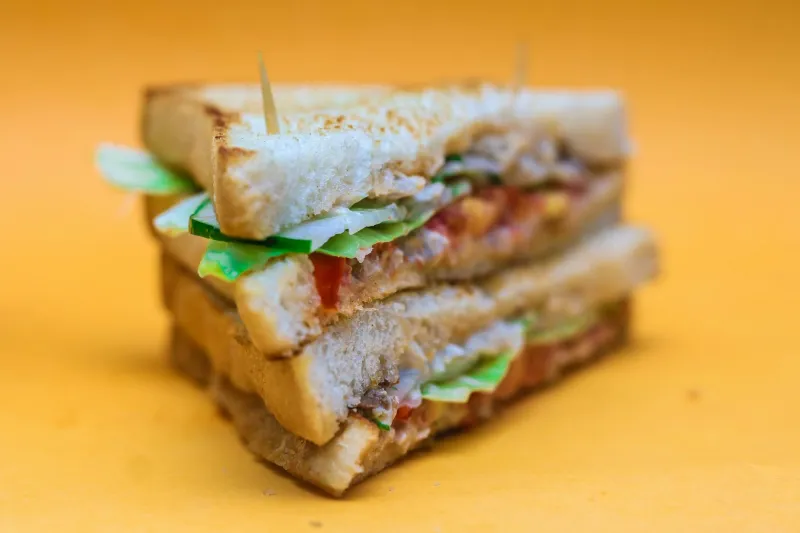
Walk into any American diner, hotel restaurant, or airport café, and you'll find it lurking on page two of the menu: the club sandwich. Three layers of toasted bread, turkey or chicken, bacon, lettuce, tomato, and mayo, held together with toothpicks and cut into triangles. It's as American as apple pie, except nobody can agree on where the hell it came from.
That's the strange thing about the club sandwich. For something so ubiquitous, its origin story is a complete mess of competing claims, each more dubious than the last.
The Gentlemen's Club Theory
The most popular origin story places the club sandwich's birth in the exclusive gentlemen's clubs of late 19th-century America. The Saratoga Club House in New York claims they invented it in 1894. The Union Club of the City of New York insists they created it even earlier. Both stories follow the same basic script: wealthy men wanted a substantial late-night snack, and some anonymous kitchen genius decided to stack everything between three pieces of toast instead of two.
There's just one problem with this theory: it's probably nonsense.
The club sandwich appears in cookbooks and newspaper advertisements throughout the 1890s, but always without attribution to any specific club. If the Union Club or Saratoga Club House had really invented America's most popular sandwich, you'd think they would have bragged about it more loudly at the time.
The Railroad Revolution
A more compelling theory points to the railroad dining cars that crisscrossed America during the Gilded Age. Train travel meant hungry passengers needed meals that could be eaten with one hand while the car swayed and lurched. The club sandwich, with its structural integrity provided by toothpicks, was perfectly designed for mobile dining.
Railroad menus from the 1890s show club sandwiches as standard offerings, often described as "hearty" or "substantial" — code words for meals that would keep wealthy passengers satisfied during long journeys. The triple-decker design wasn't just about taste; it was about engineering a sandwich that could survive the bumpy ride from Chicago to San Francisco.
This theory makes sense when you consider how many "classic" American foods were actually solutions to transportation problems. The hamburger gained popularity because it was portable. Pizza became an American staple partly because it traveled well in delivery boxes. The club sandwich might have conquered America because it was the perfect train food.
The Hotel Connection
By the early 1900s, club sandwiches had migrated from trains to hotel dining rooms, where they found their permanent home. Hotels loved the club sandwich because it was impressive-looking, used expensive ingredients (bacon wasn't cheap), and could be assembled quickly by kitchen staff.
More importantly, the club sandwich solved a specific problem for hotel restaurants: how to serve something substantial to guests who arrived between regular meal times. The club sandwich was filling enough to satisfy someone who missed lunch but not so heavy that it would spoil their appetite for dinner.
The Class Migration
What happened next is the most American part of the club sandwich story. A food that supposedly began in exclusive gentlemen's clubs gradually moved down the social ladder, appearing first in hotel restaurants, then in department store lunch counters, and finally in neighborhood diners and coffee shops.
This migration wasn't accidental. The club sandwich represented a particular kind of American aspiration — the idea that anyone should be able to order the same food that wealthy club members enjoyed. By the 1920s, a factory worker could walk into a diner and order the same triple-decker sandwich that railroad barons ate in their private dining cars.
The Standardization Process
The club sandwich's journey from exclusive to universal reveals something fascinating about American food culture: our ability to standardize dishes until their origins become irrelevant. By the 1940s, every restaurant in America knew what a club sandwich was, even if they had no idea where it came from.
This standardization process stripped away the club sandwich's class associations while preserving its essential characteristics. The toothpicks stayed (practical for holding everything together). The triangular cut remained (it made the sandwich look more substantial). The bacon became non-negotiable (it provided the crucial flavor contrast).
The Modern Legacy
Today, the club sandwich exists in a strange cultural space. It's simultaneously everywhere and nowhere — available at virtually every casual restaurant in America, yet rarely anyone's first choice. It's the sandwich equivalent of a reliable supporting actor: always there when you need it, never quite the star of the show.
The club sandwich's murky origins might actually be its greatest strength. Because nobody owns its creation story, everyone can claim it. It belongs to railroad dining cars and gentlemen's clubs, to hotel restaurants and highway diners, to anyone who has ever needed a substantial meal that could be eaten with their hands.
In the end, the club sandwich conquered American menus not because of where it came from, but because of what it represented: the democratic idea that good food should be accessible, portable, and satisfying. The fact that we can't agree on its origins only makes it more perfectly American — a dish that belongs to everyone because it belongs to no one.
So the next time you see a club sandwich on a menu, remember that you're looking at one of America's most successful culinary mysteries. It's a sandwich that won the war for menu space by losing the battle for historical accuracy. And somehow, that seems exactly right.