The Cardboard Ring That Saved a Coffee Chain — And Ended Up on Every Cup in America
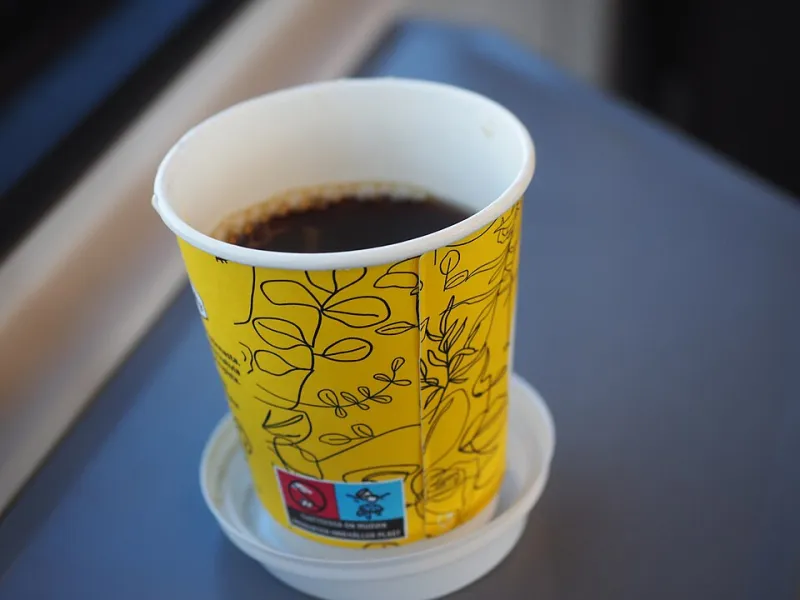
Photo: JIP, CC BY-SA 4.0, via Wikimedia Commons
You've picked it up a thousand times without thinking about it. That corrugated cardboard sleeve wrapped around your paper coffee cup — the thing that keeps your fingers from registering the full heat of the liquid inside. It's so standard now that a cup without one feels incomplete, almost reckless. But the coffee sleeve is a recent invention, it has a precise origin, and the story behind it involves a lawsuit, a Seattle coffee chain, and one man who noticed something everyone else had decided to ignore.
Before the Sleeve, There Was Just Pain
For most of the 20th century, hot coffee came in paper cups without any kind of insulating layer. At diners and lunch counters, this wasn't much of an issue — coffee was served in ceramic mugs, and paper cups were for takeout, which was relatively rare. But as American coffee culture shifted toward the grab-and-go model through the 1980s, the problem became increasingly obvious. A thin paper cup full of coffee at 160 to 180 degrees Fahrenheit is genuinely uncomfortable to hold. Most people doubled up their cups — taking two paper cups and nesting one inside the other — which solved the heat problem but wasted a cup at every transaction.
Coffee chains knew about the double-cupping habit. They accounted for it in their supply costs. It was considered an acceptable inefficiency, a small tax on the convenience model. Nobody was particularly motivated to solve it because nobody had been forced to solve it. That changed in the early 1990s, when the legal landscape around hot beverage burns shifted dramatically.
The Lawsuit Everyone Knows — And the One Nobody Talks About
The McDonald's coffee lawsuit of 1994 is one of the most famous legal cases in American consumer culture, and also one of the most misunderstood. Stella Liebeck, a 79-year-old woman, suffered third-degree burns after spilling McDonald's coffee on herself. The case became a cultural shorthand for frivolous litigation, but the actual facts — including that McDonald's had received hundreds of prior burn complaints and was serving coffee significantly hotter than industry norms — told a more complicated story. The jury awarded Liebeck nearly $3 million in punitive damages, later reduced on appeal.
That case got all the press. But there was a parallel legal drama happening in the coffee industry that received far less attention, and it's the one that actually produced the sleeve.
In the early 1990s, a Seattle-based coffee chain — not Starbucks, but one of the regional players that preceded the national chains — was facing mounting liability concerns around hot beverage burns. Customers were burning their hands. The double-cup solution was expensive and wasteful. Someone in the organization started asking whether there was a better physical solution to the heat transfer problem, and that question eventually made its way to a man named Jay Sorensen.
The Inventor Who Spilled His Coffee
Jay Sorensen was a Java Jacket customer in Portland, Oregon in 1991 when he spilled coffee on his lap while trying to hold a too-hot cup and drive simultaneously. The incident was minor — embarrassing, a little painful — but it stuck with him. He started thinking about the double-cup solution that everyone was using and wondering why nobody had come up with something better.
Sorensen spent the next few years prototyping what he called the Java Jacket: a sleeve of corrugated cardboard, similar in structure to the material used in shipping boxes, that could be slipped onto a standard paper cup and would provide an insulating air gap between the cup and the hand. The corrugation was the key — the ridged structure created small pockets of air that acted as thermal insulation without adding significant weight or cost to the cup.
He filed for a patent in 1993 and received it in 1995. By that point, the coffee industry's liability concerns had made his timing almost perfect. The McDonald's case had put every food service company in America on notice about hot beverage burns. Coffee chains were actively looking for solutions. Sorensen's Java Jacket was simple, cheap — less expensive than a second paper cup — and it worked.
Starbucks and the Tipping Point
Starbucks adopted the coffee sleeve in the mid-1990s, and that adoption was essentially the moment the product went from clever regional solution to industry standard. When Starbucks moved, the rest of the coffee service industry followed. By the late 1990s, the corrugated sleeve was ubiquitous at coffee chains, independent cafés, convenience stores, and fast food restaurants across the country.
Sorensen's company, Java Jacket, grew into a significant business. He licensed the design and eventually became something of a quiet celebrity in the food service industry — the man who solved a problem that had been costing coffee chains money and customers fingers for years. His patent expired in 2012, which is why you now see countless variations of the sleeve design from dozens of manufacturers. The basic corrugated concept is free for anyone to use, and everyone does.
A Piece of Cardboard That Carried a Bigger Idea
The coffee sleeve is a good example of something that happens more often than people realize: a legal or liability crisis forces an industry to confront a design problem it had been ignoring, and the solution turns out to be better for everyone. The double-cup habit wasn't just wasteful — it was a workaround, a patch on a problem that had a real solution. It just took a lawsuit, a spilled cup in Portland, and a few years of prototyping to find it.
Next time you slide that corrugated ring onto your morning cup, you're holding the physical result of a liability crisis, an accidental invention, and one man's mildly inconvenient commute. That's a lot of history for something that fits in the palm of your hand.