The Bread Basket Was Never About Being Nice — It Was About Managing You
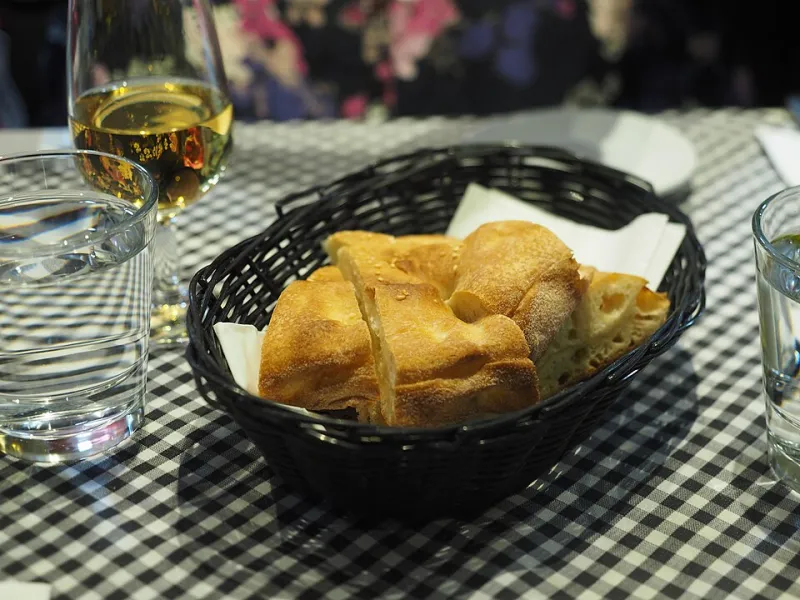
Photo: JIP, CC BY-SA 4.0, via Wikimedia Commons
The bread arrives before you've ordered. Before you've even decided if you want an appetizer. A basket of warm rolls, maybe a little dish of butter or a pour of olive oil, set down on the table like a gift. It feels like hospitality. It feels like a restaurant saying, welcome, relax, you're taken care of. It is not that. It is, and has always been, a business decision — one of the most effective in the history of the restaurant industry. And once you understand where it came from, you'll never look at that basket the same way again.
Paris, the 1920s, and a Problem With Impatient Diners
The modern sit-down restaurant, as Americans understand it, was largely a French invention. By the early 20th century, Parisian dining culture had developed most of the conventions we still recognize today: fixed menus, tableside service, the expectation that a meal was an event rather than a transaction. But with that formality came a practical problem. Preparing a proper multi-course meal took time, and diners — especially the growing middle-class clientele who were newer to restaurant dining — didn't always have the patience to sit empty-handed while the kitchen worked.
Restaurant owners in Paris during the 1920s were dealing with something that any modern service industry worker would recognize: the perception gap between how long something actually takes and how long it feels like it takes when you have nothing in front of you. Idle diners complained. They flagged down servers. They left bad impressions even when the food was excellent. Something needed to fill the gap between sitting down and being served, and it needed to be cheap, fast, and satisfying enough to keep people calm.
Bread was the obvious answer. It was inexpensive, it required no real preparation, it could be portioned in advance, and — this part matters — it was filling. A few rolls and some butter could take the edge off genuine hunger quickly, which meant customers were less agitated by the time their actual food arrived. It wasn't generosity. It was crowd management.
The Economics Were Almost Embarrassingly Simple
Here's the part of the bread basket story that the restaurant industry doesn't advertise: the food cost on a basket of bread is almost nothing. Even in fine dining, where the rolls might be house-made with good butter, the per-person cost of the bread service is a fraction of a dollar. The return on that investment, however, is substantial.
A calmed, slightly full diner is a better customer. They're less likely to complain about wait times. They're more relaxed when ordering, which means they're more likely to be influenced by server suggestions. And — this is the counterintuitive part — a diner who has already eaten some bread is paradoxically more likely to order a full meal rather than scaling back. The mild satiation removes the anxiety of hunger, which allows people to make more deliberate, often more generous, ordering decisions.
Restaurant consultants have been aware of this dynamic for decades. The bread basket isn't just a courtesy — it's part of what the industry calls "pacing the experience," a deliberate sequencing of small satisfactions designed to keep the customer engaged and comfortable from the moment they sit down. The basket signals that the meal has begun, even before the first course is ordered.
How It Crossed the Atlantic
The practice migrated to American restaurants in the 1930s and 1940s, carried partly by the influence of French dining culture on upscale American establishments, and partly by pure pragmatism. American diners of the mid-century were eating out in larger numbers than ever before, and restaurants were figuring out how to manage higher volume without sacrificing the sense of attentive service. Bread solved the same problem in New York and Chicago that it had solved in Paris a generation earlier.
By the postwar boom years, the bread basket had become so standard in American sit-down restaurants that it stopped feeling like a service choice and started feeling like a baseline expectation. Diners who didn't receive bread within a few minutes of sitting down would often ask for it, and a restaurant that didn't offer it risked being perceived as stingy or inattentive. The strategy had become a social contract.
Diner culture accelerated this. The proliferation of casual American restaurants through the 1950s and 1960s — diners, family chains, the early versions of what would become national casual dining brands — all adopted the bread basket as part of their standard service template. It was cheap, it worked, and customers expected it. Those three factors together are basically the recipe for an industry-wide standard.
The Basket in the Age of Dietary Anxiety
The bread basket has had an interesting few decades. The low-carb movement of the late 1990s and early 2000s put restaurants in an odd position — the tool that had reliably managed customer experience for nearly a century was suddenly being waved away by a significant portion of the dining public. Some restaurants responded by offering alternatives: olives, crudités, small amuse-bouche items that served the same psychological function without the carbohydrates.
But the bread basket never went away. It adapted. Upscale restaurants started offering artisan breads with flavored butters or house-made spreads, turning the preamble into a selling point. Fast-casual concepts dropped it entirely, which is fine because fast-casual solves the wait-time problem differently. And at the vast middle of American restaurant culture — the neighborhood Italian spot, the steakhouse, the family-style chain — the basket kept arriving, warm and expected, right after you sat down.
What started as a Parisian crowd-control tactic in the 1920s is now so deeply woven into the American dining experience that its absence feels like a slight. That's a remarkable run for a piece of bread. And a reminder that the most effective hospitality is often the kind that's working on you without your knowledge.