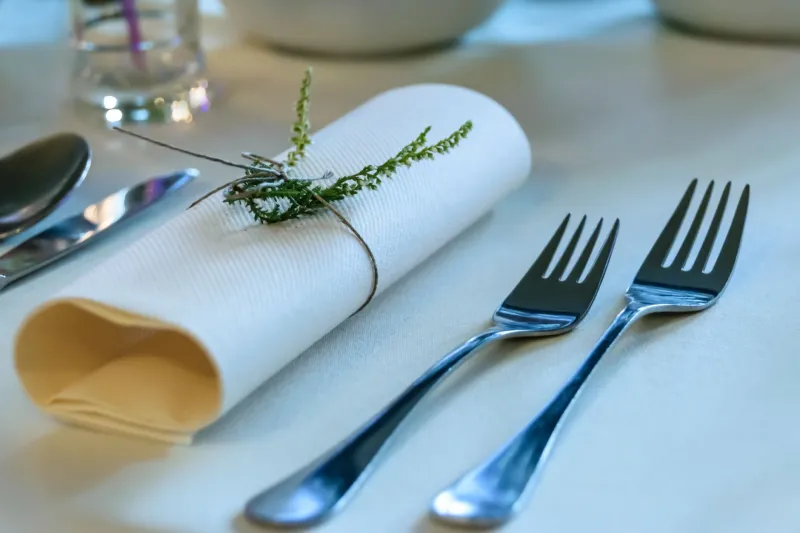
If you sat down to dinner in colonial America and reached for a fork, the person next to you might have raised an eyebrow. Not because forks didn't exist — they did — but because using one voluntarily, when you had perfectly functional fingers and a knife, was considered a little odd. Possibly pretentious. Maybe even a sign of weak character.
This is the story of how a simple piece of bent metal went from European curiosity to mandatory table equipment, and how American restaurants turned the act of eating with a fork into a class test that most people didn't know they were taking.
It Came From Italy, and That Was Already a Problem
The fork's origin story begins in eleventh-century Byzantium, but it's medieval Italy where the utensil really took hold. By the 1400s, wealthy Italian families were using two-pronged forks to eat pasta and fruit, mostly to keep their fingers clean and their clothing unstained. Venetian merchants brought the habit across Europe, and by the 1600s, forks had reached the tables of French and English nobility.
The English, for their part, weren't immediately impressed. An early English traveler named Thomas Coryat brought a fork home from Italy in 1611 and wrote enthusiastically about it. His friends called him "Furcifer" — Latin for fork-bearer, used as a mild insult — and the nickname stuck. The fork was seen as effeminate, unnecessary, and suspiciously continental. Real men ate with knives and their hands.
When European settlers arrived in America, they brought this skepticism with them. The fork showed up in some wealthy households, usually as a two-pronged serving tool rather than a personal utensil. Most Americans ate with a knife, a spoon, and their hands — and saw absolutely nothing wrong with that arrangement.
The Fingers-First Culture of Early America
Early American food culture was unapologetically hands-on. Taverns served food communally. Meats were pulled apart and eaten directly. Travelers ate standing up or on the move. The idea that you needed a dedicated piece of metal to move food from a plate to your mouth struck many Americans as a waste of time — and a sign that you'd spent too long in a European drawing room.
Even among people who owned forks, using them for every meal wasn't the norm. They were reserved for formal occasions, if that. The working majority of Americans — farmers, laborers, craftsmen — had no use for them and no interest in acquiring any.
The four-pronged fork we'd recognize today didn't become common until the late 1700s in Europe, and it took even longer to make inroads in America. As late as the early 1800s, the fork was still something of a luxury item, found in wealthy homes and largely absent from everyone else's.
How Restaurants Changed the Calculation
The shift came not from home kitchens but from dining rooms — specifically, from the rising class of American restaurants that emerged in the mid-1800s as cities grew and a new middle class needed places to eat and be seen eating.
Restaurants in New York, Boston, and Philadelphia began setting their tables with elaborate arrangements of cutlery. Multiple forks. Multiple knives. Spoons of different sizes. The visual complexity of a properly set table sent an immediate message: this is a place for people who know things. And if you didn't know which fork to pick up first, everyone could see it.
This wasn't accidental. Upscale restaurants understood that table manners were a sorting mechanism. The rules of formal dining — which fork for the salad, which for the entrée, never switching the fork to your right hand after cutting — created a performance that separated people who'd been taught these things from people who hadn't. It was a way of making certain diners feel at home and others feel like they didn't belong.
Etiquette books, which proliferated in the second half of the nineteenth century, codified these rules obsessively. Authors like Catharine Beecher and later Emily Post turned fork-holding into a moral category. Using your fork incorrectly wasn't just a social slip — it was evidence of poor upbringing, insufficient refinement, and a failure to meet the standards of civilized life.
The Fork Becomes Mandatory
By the 1880s, the fork had completed its transformation from optional to obligatory. American restaurants expected it. American schools taught it. American etiquette books treated it as a basic requirement of civilized behavior — which is a remarkable turn for an implement that, a century earlier, had been considered foppish.
The four-pronged fork became the standard. Place settings became formalized. And the idea that eating without a fork was somehow primitive or unclean lodged itself firmly in American middle-class identity.
This had real consequences. It affected which cuisines were taken seriously in public dining spaces. Foods eaten with hands — whether at immigrant tables, in Southern barbecue traditions, or in Indigenous communities — were quietly coded as less sophisticated. The fork didn't just change how Americans ate. It became a tool for defining who counted as properly American.
The Utensil That Never Stopped Performing
Today, the fork sits so naturally at the left side of every plate that it's invisible. Nobody questions it. Children are taught to use it before they're taught most other social skills. Restaurants that serve food meant to be eaten with hands — wings, tacos, dumplings — still put forks on the table, almost apologetically.
But the fork's authority was never really about hygiene or efficiency. It was about signaling. It was about making certain people feel correct and others feel watched.
The four-pronged fork was invented in Italy, mocked in England, ignored in early America, and then quietly declared mandatory by a restaurant industry that figured out how to turn table settings into a test. The utensil itself is neutral. What people decided it meant — that's the part worth chewing on.