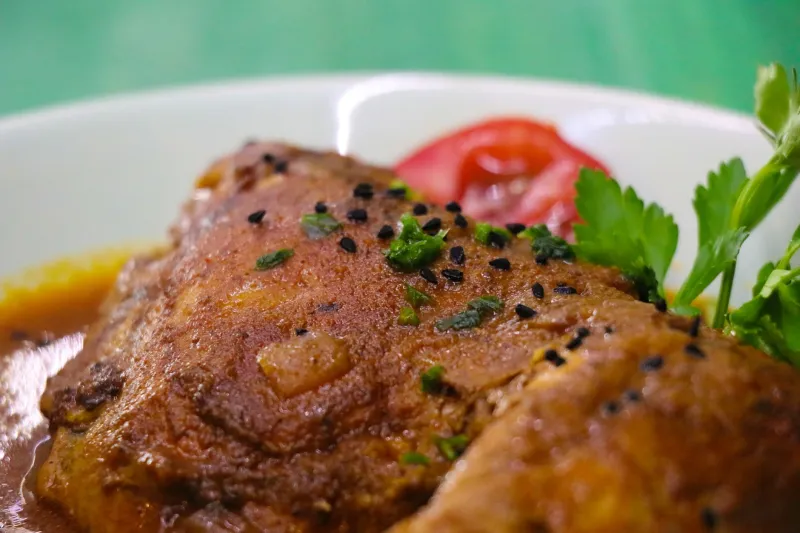
At some point tonight, somewhere in America, a plate will arrive at a table with a small sprig of curly parsley tucked against the edge. Nobody will eat it. The diner will move it aside, eat their meal, and leave the parsley sitting there like a tiny, abandoned Christmas tree. The server will carry it back to the kitchen. Someone will throw it away.
This ritual happens millions of times a day across the country. And almost nobody stops to ask why the parsley is there in the first place.
The answer is older, stranger, and more revealing than you'd expect.
When Garnish Had a Job to Do
Before refrigeration, before health codes, before the USDA had anything to say about food safety, keeping meat from going bad was a daily gamble. Medieval European kitchens operated in a constant negotiation with spoilage. Meat was salted, smoked, spiced, or pickled — not primarily for flavor, but to slow the inevitable. And when those methods weren't enough, cooks got creative.
Herbs became a practical tool. Parsley, rosemary, and other strongly scented plants were placed around or on top of food not because they looked nice, but because they masked the smell of meat that was on its way out. A dish that arrived fragrant with fresh herbs signaled — or at least implied — that the food beneath it was worth eating. Whether that was true was sometimes a matter of faith.
This wasn't deceptive in the way we'd understand it today. It was pragmatic. In a world without cold storage, you used what you had. Herbs were abundant, aromatic, and effective at confusing the nose. They also had genuine antimicrobial properties that weren't fully understood at the time but were observed well enough to be trusted.
Garnish, in other words, began as camouflage. A very green, very fragrant kind of camouflage.
How Decoration Became Status
By the time the Renaissance hit European cooking, food presentation had become something else entirely. The kitchens of wealthy nobles and merchant families weren't just feeding people — they were performing power. Elaborate table presentations, sugar sculptures, and architecturally arranged dishes announced that the host had resources to spare. You didn't just eat at a wealthy table; you witnessed it.
Herbs and garnishes evolved to fit this context. They stopped being about food safety and started being about aesthetics. French haute cuisine, which dominated European fine dining from the seventeenth century onward, codified elaborate plating as a mark of professional skill. A dish presented without attention to its appearance was a dish presented without care — or worse, without knowledge.
When French culinary traditions crossed the Atlantic and took root in American fine dining during the 1800s, they brought this plating philosophy with them. The garnish wasn't just acceptable — it was expected. A plate without decoration was a plate that hadn't tried.
The Restaurant Turns It Into Theater
American restaurants of the late nineteenth and early twentieth centuries embraced garnish with particular enthusiasm, and for reasons that went beyond aesthetics. A beautifully presented plate justified a higher price. It communicated that the kitchen took its work seriously. It gave diners something to admire before they ate, which primed them to enjoy the meal more — a psychological effect that food researchers have since confirmed is real and measurable.
The curly parsley sprig became a standard because it was cheap, durable, visually consistent, and available year-round. It didn't wilt quickly under heat lamps. It photographed well before anyone was photographing food. It could be prepped in bulk and applied uniformly across hundreds of plates during a dinner service. For a busy kitchen trying to maintain a polished presentation without adding labor, parsley was the obvious answer.
The lemon wedge appeared for similar reasons — functional in theory (you could squeeze it), decorative in practice (most people didn't). The tomato rose, the radish fan, the cucumber curl: these were all part of a plating vocabulary that said this kitchen has standards while adding essentially zero calories and almost no flavor to the dish.
What Chefs Are Actually Saying
Here's where it gets interesting. Modern chefs will tell you that garnish has never really stopped being a form of communication — it's just that the message has gotten more layered.
A thoughtfully placed herb on a contemporary restaurant plate isn't random. It might indicate what's in the dish (a basil leaf on pasta, a dill frond on salmon). It might signal a flavor relationship — a squeeze of acid, a pop of bitterness — that the chef wants you to encounter. At high-end restaurants, the garnish is often the most technically demanding element on the plate: a precisely placed microgreen, a single edible flower chosen for its flavor profile, a dusting of something that took three days to prepare.
At casual restaurants, the parsley sprig is mostly habit. It's there because it's always been there. Kitchen staff add it without thinking about it, the way you might say "have a good day" to someone leaving a store — not because you've considered the sentiment, but because omitting it would feel strange.
Nobody Eats It, and That's the Point
The fact that most garnish goes uneaten is not a bug. It never was. The parsley on your plate was not intended to be eaten by the medieval cook who put it there — it was intended to be smelled. The decoration on a Renaissance nobleman's table wasn't food; it was architecture. The curly parsley on a 1970s steakhouse plate wasn't a side dish; it was a frame.
Garnish has always been about the experience around the food, not the food itself. It's the restaurant's way of saying: we thought about this. Whether that's true is another question.
The herb garden on your plate has survived for centuries because it keeps doing its job — even when nobody can quite remember what that job was. It started as a trick to hide something. Now it's a signal, a habit, and a very small piece of theater that plays out on every table, every night, all across America.
And then someone throws it away, and the whole thing starts again.