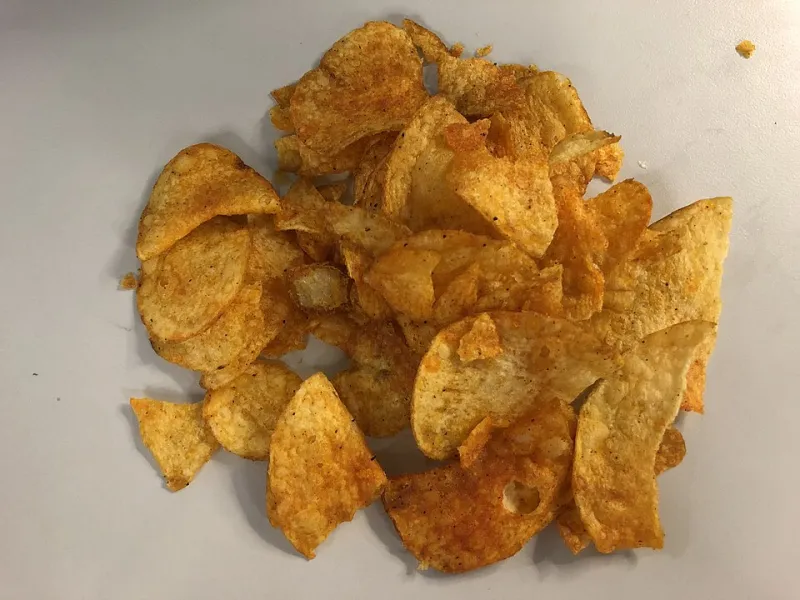
Photo: Famartin, CC BY-SA 4.0, via Wikimedia Commons
Ask someone from Memphis what barbecue tastes like and they'll describe dry-rubbed pork ribs with a paprika-heavy crust and a vinegar tang that cuts through the fat. Ask someone from Kansas City and you'll hear about thick, molasses-dark sauce and low-and-slow brisket. In the Carolinas, you're getting whole-hog pork with a sharp, thin vinegar sauce that would make a Kansas City pitmaster nervous. In Texas, the answer is beef. Always beef. With smoke. Lots of smoke.
 Photo: Kansas City, via c8.alamy.com
Now open a bag of barbecue chips and take a bite.
What you taste isn't any of those things — and yet, somehow, it's all of them at once. That's not an accident. It's one of the more quietly brilliant feats of mid-century American food science, and it has a history that stretches from Native American cooking fires to a snack food laboratory in the 1950s.
Where Barbecue Actually Came From
The word itself is old — older than the United States, older than European settlement of North America as a going concern. It likely derives from barbacoa, a term used by the Taíno people of the Caribbean to describe a wooden framework used to slow-cook or smoke meat over fire. Spanish colonizers encountered the technique in the 1500s and carried the word north with them as they moved through what would become the American South.
By the time enslaved Africans were doing the majority of the cooking on Southern plantations in the 17th and 18th centuries, barbecue had already absorbed multiple culinary traditions — Indigenous smoking methods, West African seasoning techniques, and the practical necessity of making tough, inexpensive cuts of meat palatable through long, slow cooking. The result was a cooking tradition that was deeply regional, community-rooted, and almost impossible to standardize.
Different woods burned differently. Different animals were available in different places. Different communities developed their own spice blends, their own sauce philosophies, their own timing rituals. Barbecue wasn't a flavor. It was a practice — and a fiercely local one.
The Problem With Selling Something You Can't Agree On
By the early 20th century, as American food companies began industrializing everything from bread to breakfast cereal, barbecue presented a genuine marketing puzzle. It was beloved across the South and spreading in popularity nationwide, but it meant completely different things depending on where you were standing.
You couldn't put a Memphis dry-rub and a Carolina vinegar mop and a Kansas City molasses glaze in the same bottle and call it barbecue sauce. You'd please nobody. What you needed was an abstraction — a flavor profile that suggested barbecue without committing to any specific regional tradition. Something smoky. Something sweet. Something with a little heat and a little tang. Something that tasted like the idea of cooking over fire without requiring an actual fire.
Food scientists in the mid-20th century got to work.
The Chip That Launched a Flavor Category
The first commercially successful barbecue-flavored potato chip appeared in the early 1950s, though the exact origin is contested — a familiar theme in American snack food history. What's clear is that by the mid-1950s, multiple chip manufacturers were experimenting with powdered seasoning blends designed to evoke smoked, slow-cooked meat without containing any of it.
The formula that emerged — and that still underlies most barbecue-flavored products today — typically combined smoked paprika for color and smoke suggestion, onion and garlic powder for savory depth, brown sugar for sweetness, a vinegar component for tang, and cayenne or chili powder for heat. No actual smoke. No actual meat. Just a carefully calibrated set of signals that the brain associates with the experience of barbecue.
It worked spectacularly. Barbecue chips became one of the top-selling flavors in the American snack food market within years of their introduction, a position they've never really surrendered. And the flavor template they established became the foundation for an entire category of products — barbecue sauces engineered for mass-market palatability, barbecue seasonings sold in supermarket spice aisles, barbecue-flavored everything from pork rinds to sunflower seeds to beef jerky.
A Flavor That Belongs to No Place
What's interesting — and a little strange, when you sit with it — is that the barbecue flavor most Americans know best is the one least connected to any actual barbecue tradition. The chip version, the sauce bottle version, the seasoning packet version: these are synthetic composites designed in food laboratories to appeal to the broadest possible audience, not expressions of any specific regional cooking culture.
The real traditions are still very much alive. Competition barbecue is a serious sport in this country. Pitmasters in the Carolinas and Texas and Tennessee are doing extraordinary work. Regional barbecue culture is arguably having a moment of renewed appreciation. But that culture exists largely separate from the mass-market flavor it accidentally inspired.
When Americans say they love barbecue — and polls consistently show they do — many of them are describing a flavor invented by food chemists, not a technique passed down through generations of pit cooking. The two things share a name and some overlapping ingredients. Beyond that, they've been living parallel lives for seventy years.
Why It Still Matters
The barbecue chip story is a useful window into how American food culture actually works. A regional tradition — rooted in Indigenous knowledge, shaped by African culinary expertise, developed over centuries — gets abstracted, simplified, and industrialized into a mass-market flavor that most people consume without any connection to its origins.
That's not entirely a tragedy. The flavor is genuinely popular because it's genuinely satisfying. But it's worth knowing that the barbecue taste on your chip isn't really barbecue. It's the ghost of barbecue, conjured in a lab and sold at scale.
Somewhere, a pitmaster is tending a fire that's been burning since 4 a.m. What's in your chip bag is something else entirely.