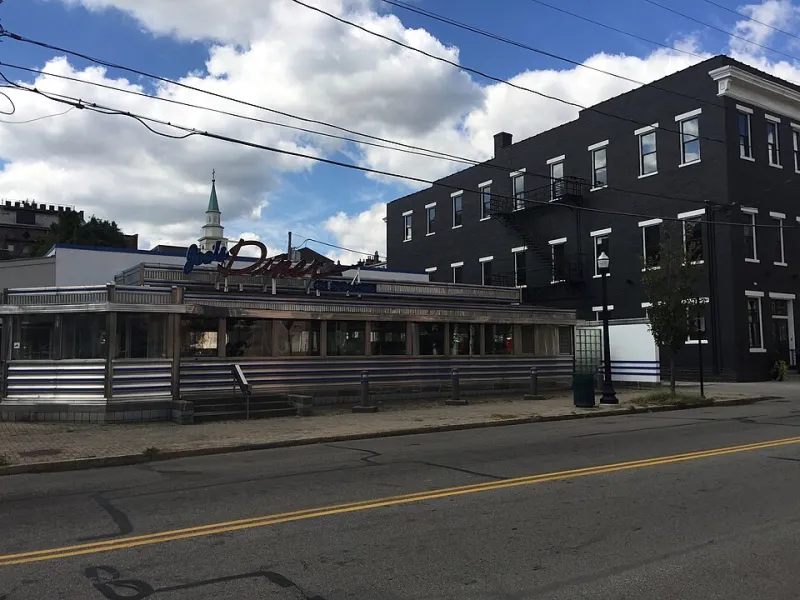
Photo: Warren LeMay from Cincinnati, OH, United States, CC0, via Wikimedia Commons
The Spinning Glass Case That Wasn't Really About Pie
Walk into almost any classic American diner and there it is: the pie case. Usually near the counter, often backlit, almost always rotating slowly like it has somewhere to be. Slices of cherry, lemon meringue, chocolate cream, and coconut custard making their patient, circular journey behind foggy glass. It's one of the most recognizable images in American food culture — warm, nostalgic, deeply comforting.
It's also, when you look at its actual history, a piece of calculated behavioral design that had almost nothing to do with keeping pie fresh and everything to do with keeping customers seated, spending, and coming back.
The Economics of the Mid-Century Diner
To understand why the pie case exists, you have to understand how brutally thin the margins were for roadside and neighborhood diners in the mid-20th century. The postwar diner boom of the 1940s and 1950s brought thousands of new operations onto American highways and into American towns, but it also brought intense competition. A cup of coffee might cost a dime. A full plate of eggs, toast, and bacon might run fifty cents. Keeping a diner profitable meant moving a high volume of customers — but it also meant finding ways to increase what each customer spent before they left.
Dessert was the answer. A slice of pie represented one of the highest markup items on a diner menu. The ingredients were cheap, the labor was manageable, and the price a customer would willingly pay for a slice of homemade-looking pie was significantly higher than the cost to produce it. The challenge was getting customers who had just finished a full meal to order one.
This is where the display case entered the picture — not as a storage solution, but as a sales tool.
Designed to Make You Hungry When You Weren't
The revolving pie case was engineered to solve a specific problem: how do you sell dessert to someone who just said they were full?
Restaurant supply companies and diner designers understood, even without formal behavioral science language to describe it, that visual temptation operated differently than menu temptation. A description of "chocolate cream pie" in text on a menu is easy to decline. An actual slice of chocolate cream pie, rotating slowly at eye level, catching the light, looking exactly like the dessert your grandmother made — that's a different kind of persuasion.
Placing the case near the counter or at the entrance meant customers encountered it both when they arrived and when they were deciding whether to order one more thing before paying. The rotation was not incidental: a stationary case is a display. A rotating case is a performance. It implies abundance, variety, and — crucially — that each slice is equally available and equally worthy of your attention.
Diner operators quickly learned that a well-stocked, well-lit pie case measurably increased dessert orders. Locations that removed their cases and relied on menus alone reported lower dessert sales. The case wasn't just showing you what was available. It was changing what you wanted.
The Portion Architecture of Comfort Food
The pie case also had a quieter influence on American dessert culture: it standardized the slice. When pie was cut in advance and displayed behind glass, it had to be cut in a way that looked appealing and consistent. Diners settled on the familiar one-sixth or one-eighth cut — generous, photogenic, and substantial enough to justify the price.
This portion expectation became so embedded in American food culture that it essentially defined what a "serving" of pie meant. Home bakers began cutting their pies to match what people had come to expect from diners. Bakeries followed. The diner slice became the default American pie serving, and it was sized not for nutritional logic but for visual impact in a glass case.
The whipped cream on top — another diner staple — served a similar function. It added height, which made slices look more substantial and more appealing from across the room. It also added almost nothing to the cost while significantly increasing the perceived value of the product. Diner owners weren't doing behavioral economics with spreadsheets, but they were doing behavioral economics.
Why the Case Still Matters
The pie case survived the decline of the classic roadside diner and has become one of the most durable symbols of American comfort food culture. Modern restaurants that want to project a sense of warmth, nostalgia, or unpretentious hospitality frequently install some version of it — even when the economics of doing so barely make sense by contemporary standards.
There's a reason. The rotating pie case communicates something that menus and Instagram photos can't quite replicate: it says that someone made these things by hand, that there's abundance here, and that you are welcome to stay a little longer and have something sweet. Those are powerful messages in an era of fast-casual efficiency and digital ordering.
What's interesting is that the case still works. Restaurants that display food visibly — whether it's a pastry case at a bakery, a rotisserie chicken turning in a window, or a sushi bar where the fish is right in front of you — consistently report higher sales of those items than comparable operations that rely on descriptions alone. The behavioral insight that diner operators stumbled onto in the 1940s has been confirmed repeatedly by modern consumer research.
The pie didn't need to be displayed to be sold. But displayed, it sold itself.
A Piece of Furniture That Shaped a Culture
It's a strange thing to trace a significant piece of American food culture back to a piece of restaurant equipment. But the diner pie case is a genuinely useful lens for understanding how the environment of eating shapes the experience of eating — what we order, how much we spend, what we remember, and what we come to expect.
American comfort food didn't develop its visual identity in a vacuum. It developed in specific physical spaces, designed by people who needed to make a living, who figured out through trial and error that a slowly spinning slice of cherry pie was one of the most effective marketing tools they had.
So next time you're sitting at a diner counter and find yourself ordering a slice of pie you didn't plan on, take a look at that rotating case. It's doing exactly what it was built to do.