The Machine Nobody Noticed That Rewired How America Shops for Food
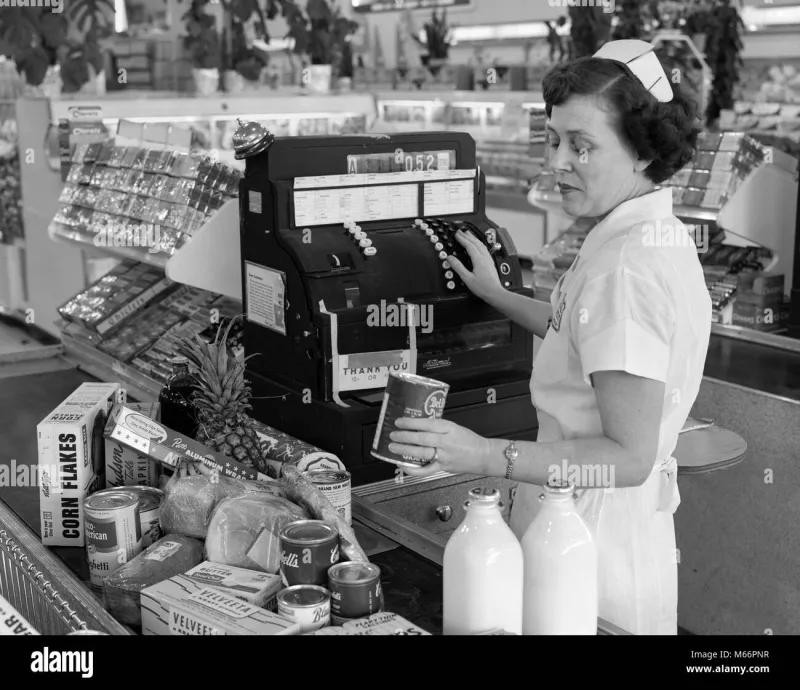
Photo: vintage paper grocery bag 1950s American supermarket checkout counter, via c8.alamy.com
Think about the last time you grabbed something at a grocery store you didn't plan to buy. A bag of chips near the register. A bakery roll that smelled too good to ignore. A bottle of something on sale that you tossed in the cart without thinking twice. That moment — that small, impulsive decision — has a specific origin story. And it has almost nothing to do with marketing psychology or store layout.
It has everything to do with a paper bag.
Before the Bag, Shopping Was a Ceremony
In the mid-1800s, buying food in America was a deliberate, almost ritualistic act. You didn't wander a store. You arrived with a purpose and a container — a wicker basket, a cloth sack, a wooden barrel you'd haul back to the merchant to be refilled. Dry goods like flour and sugar were scooped from large bins and wrapped in paper by hand, twisted at the corners, and handed over like a present. Produce went into whatever you'd brought from home.
The system worked, but it had an invisible ceiling. You could only buy what you could carry. And you could only carry what you planned for. Impulse purchasing — the financial engine of modern retail — was structurally impossible. If you hadn't brought the right container, you couldn't take the product home. Shopping wasn't browsing. It was logistics.
This wasn't just inconvenient. It fundamentally limited how much food moved through the American economy at any given moment.
A Mill Worker's Daughter Changes Everything
Margaret Knight grew up working in a Massachusetts cotton mill as a child — not exactly the biography of someone destined to transform American commerce. But Knight had an obsessive, restless mind, and by the 1860s she'd already invented a safety device for textile looms that was adopted industry-wide without her receiving a cent of credit.
 Photo: Margaret Knight, via img.freepik.com
She wasn't going to let that happen twice.
In the late 1860s, Knight turned her attention to paper bags. Flat-bottomed bags — the kind that could actually stand up, hold volume, and carry real weight — were still being folded and glued by hand, one at a time, by workers in paper mills. The process was slow, expensive, and wildly inconsistent. Knight designed a machine that could cut, fold, and paste flat-bottomed bags automatically, producing them at a scale no human hand could match.
When a male colleague attempted to patent her design before she could, Knight sued him — and won — in 1871, securing one of the most significant patents in American retail history. Her machine could produce bags faster than anything that had come before, and the flat-bottomed design meant those bags could sit upright, hold groceries without collapsing, and be carried by anyone without any preparation.
For the first time, a store could hand you something to take your purchases home in. You didn't need to bring anything. You just needed to show up.
The Grocery Store Was Waiting for This Moment
The timing was almost eerie. The late 19th century was exactly when American retail was beginning to shift from small specialty merchants — the butcher, the baker, the dry goods store — toward larger, consolidated shops that carried multiple categories under one roof. The concept of the general store had existed for decades, but the idea of a customer wandering freely through shelves of products and choosing their own items was still radical.
The paper bag made that model viable. Suddenly, a store could stock more variety because customers could carry more variety home. You didn't need to plan around your basket's capacity. You didn't need to send someone back for a second trip. You grabbed what caught your eye, and the bag handled the rest.
By the early 20th century, as supermarkets began appearing in American cities and suburbs, the paper bag was already woven into the architecture of the experience. Clarence Saunders opened Piggly Wiggly in Memphis in 1916 — widely credited as the first true self-service grocery store — and the bag was essential to the model. Customers moved through aisles, selected their own products, and a bag waited for them at checkout. The whole choreography depended on it.
Fast Food Borrowed the Logic
Decades later, when fast food began its own explosion across American roadways in the 1950s and '60s, the paper bag showed up again — this time as a carry-out container. McDonald's, Burger King, and every drive-in that followed handed food to customers in bags, making meals genuinely portable for the first time. You could eat in your car. You could take it to a park. You could carry a family's worth of food in one hand.
The bag didn't just enable fast food. It defined what fast food could be. Without it, a meal from a drive-through window would have required a tray, a table, a sit-down experience — which is to say, it wouldn't have been fast food at all.
The Thing We Never Think About
Margaret Knight's name isn't on a plaque in any grocery store. Her invention isn't celebrated the way the microwave or the refrigerator is. But the flat-bottomed paper bag sits at the foundation of modern American food culture in a way that's almost impossible to overstate.
It enabled impulse buying. It made self-service retail practical. It gave fast food its portability. And it turned grocery shopping from a planned ritual into a casual, flexible, sometimes spontaneous act that most Americans now do without a second thought.
The next time you grab something at the register you didn't intend to buy and drop it into a paper bag, you're living out the downstream consequence of one woman's patent fight in 1871. The bag made that moment possible. It just never bothered to take credit.