The Sprig That Outlived Its Reason: America's Long Relationship With Plate Garnish
The Sprig That Outlived Its Reason: America's Long Relationship With Plate Garnish
At some point in the last century, someone in a restaurant kitchen placed a small sprig of curly parsley on a plate and sent it out to a dining room. The diner looked at it, wasn't sure what to do with it, and left it on the plate. The server cleared it away. The kitchen put another one on the next plate. This happened approximately one billion times across the United States over the following several decades.
Nobody was really sure why. And yet the parsley kept appearing.
This is the story of how a Victorian presentation ritual crossed the Atlantic, moved through hotel banquet halls, filtered into American diner culture, and eventually became one of the most reflexive, unexamined habits in the history of restaurant kitchens — long after anyone could remember what it was supposed to mean.
It Started With Wealth Signaling, As Most Things Do
To understand the parsley sprig, you have to go back to 19th-century European fine dining, where the presentation of food was as important as its taste — and sometimes more so. In the grand restaurants of Paris and London, and in the aristocratic households that set the tone for everything below them, a plate wasn't just a vehicle for food. It was a statement.
Garnishes in this context were elaborate, intentional, and expensive. Carved vegetables, aspic molds, decorative sauce arrangements — these were signals that the kitchen had skilled labor, that the household had resources to spend on aesthetics, and that the guests were worth impressing. Parsley, being green, affordable, and visually distinct from most cooked foods, became a reliable standby in the garnish toolkit. It provided color contrast, implied freshness, and required almost no skill to place on a plate.
It was, in other words, the easiest way to make a plate look finished.
How It Crossed the Atlantic
When European fine dining traditions arrived in America in the late 19th and early 20th centuries, they came largely through hotel kitchens. The great American hotels of the Gilded Age — the Palmer House in Chicago, the Waldorf in New York, the Brown Palace in Denver — were staffed by European-trained chefs who brought continental plating conventions with them wholesale.
 Photo: Brown Palace, via media.9news.com
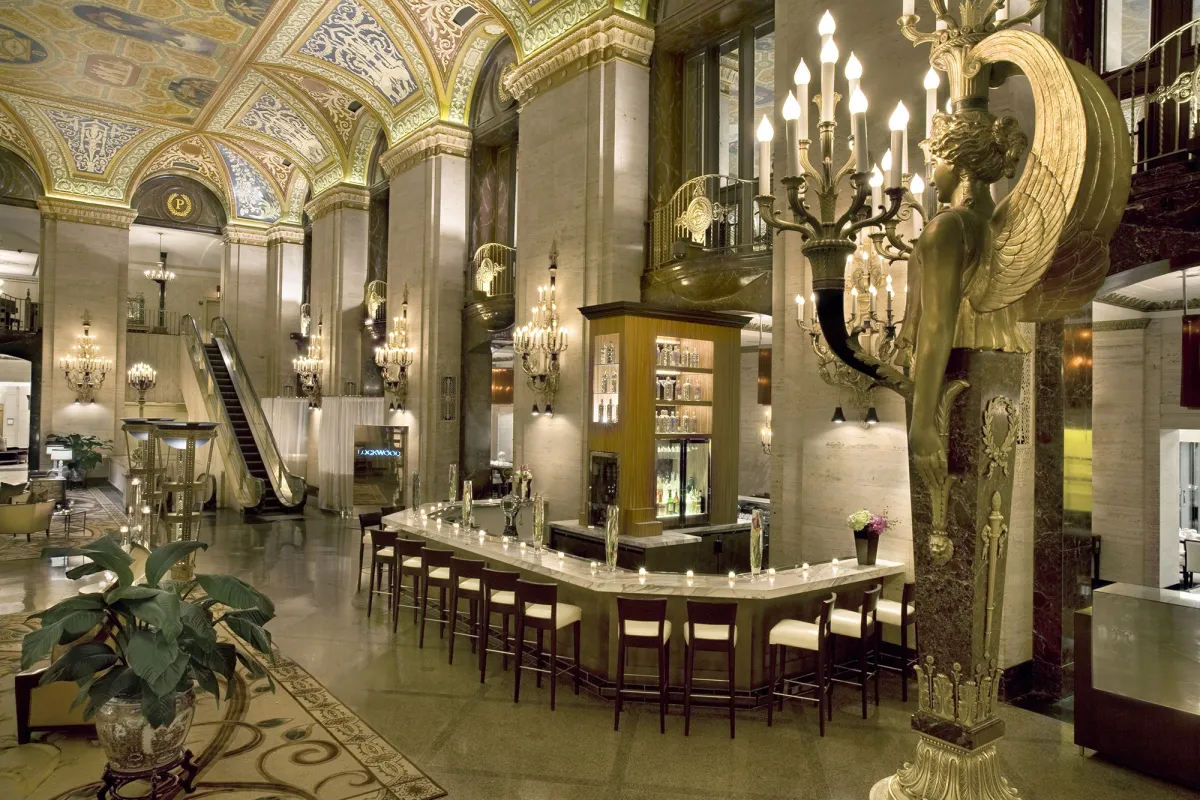 Photo: Palmer House, via s3.amazonaws.com
These hotel kitchens trained a generation of American cooks. Those cooks moved into other restaurants. The restaurants trained more cooks. And the habits that had originated in Parisian haute cuisine began migrating down the food chain — from grand hotel dining rooms to mid-range steakhouses to coffee shops to diners — carrying the parsley sprig with them at every step.
By the mid-20th century, the garnish had become so standard that it appeared in culinary textbooks as a basic plating principle. Not as a choice, but as a rule. A plate without a garnish looked unfinished. A plate with a parsley sprig looked like it came from a real kitchen. The reasoning behind the rule had largely evaporated, but the rule itself was firmly in place.
The Professional Kitchen Logic That Kept It Alive
Restaurant kitchens are, among other things, systems for managing chaos under pressure. When a kitchen is running fifty covers in an hour, the last thing a line cook needs is ambiguity. Standards exist precisely to eliminate decision-making at the point of execution. You don't think about whether a plate needs garnish. You put the garnish on the plate. Every plate. Always.
This operational logic is part of why the parsley sprig survived so long past its cultural expiration date. Once it was encoded into kitchen procedure, removing it required an active decision — a chef or owner consciously choosing to break with established practice. And breaking with established practice in a restaurant kitchen carries risk. Regulars notice changes. Critics notice changes. The absence of something expected can read as carelessness even when it's intentional.
So the parsley stayed. Not because anyone loved it. Not because it improved the food. But because it was easier to keep doing it than to explain why you'd stopped.
What Diners Actually Did With It
Here's what makes the parsley sprig genuinely strange as a cultural artifact: it was never really intended to be eaten, and most diners seemed to understand this instinctively without anyone telling them. Curly parsley — as opposed to flat-leaf Italian parsley — has a bitter, slightly medicinal flavor that doesn't pair especially well with most American restaurant food. It's also tough and a little chewy in a way that feels out of place at the end of a meal.
Surveys and food writers from the mid-20th century onward noted with some regularity that diners consistently left the parsley on the plate. Restaurant operators knew this. Kitchen staff knew this. And yet the parsley continued to be purchased, prepped, and placed on plates in quantities that, added up across the country, must represent a genuinely staggering amount of wasted food.
Some diners did eat it — parsley is, after all, nutritious, and it does function as a mild palate cleanser. But the majority treated it as decoration, which is exactly what it was. A visual signal with no practical function that had survived entirely on institutional momentum.
When It Finally Started Disappearing
The parsley sprig's decline in American restaurants tracks roughly with the broader shift toward more casual dining culture in the 1980s and '90s, and the rise of a culinary philosophy that prioritized authenticity over formality. As chefs began pushing back against convention and asking why things were done the way they were done, the curly parsley sprig became a kind of symbol for reflexive, unexamined tradition.
New American cuisine, farm-to-table cooking, and the general loosening of fine dining codes all contributed to a kitchen culture that was more skeptical of garnish for garnish's sake. If something was on the plate, it should be there for a reason — flavor, texture, or a meaningful visual contribution. A wilting sprig of curly parsley that nobody was going to eat didn't clear that bar.
The garnish didn't disappear entirely. It evolved. Microgreens, herb oils, edible flowers, and thoughtfully placed sauce dots replaced the parsley sprig with decorative elements that at least pretended to serve a culinary purpose. Presentation culture didn't die — it just got more self-conscious.
What the Parsley Tells Us
The history of the parsley sprig is, at its core, a story about how professional rituals travel and persist. A convention that made genuine sense in one context — European fine dining, where presentation was a deliberate status signal — migrated into a completely different context, lost its original meaning, and kept going anyway on the strength of habit and institutional inertia.
Food culture works this way more often than most people realize. The things on your plate — and the things that used to be on your plate — often carry the ghosts of reasoning that dissolved decades ago. The parsley was never really about parsley. It was about what a finished plate was supposed to look like, in a tradition you inherited without asking for it.
Somewhere right now, in a kitchen that hasn't updated its plating standards since 1987, someone is still putting the sprig on the plate. Old habits have long roots.